Sleep Temperature Optimization: Why Your Bedroom Temperature Is Sabotaging Your Sleep
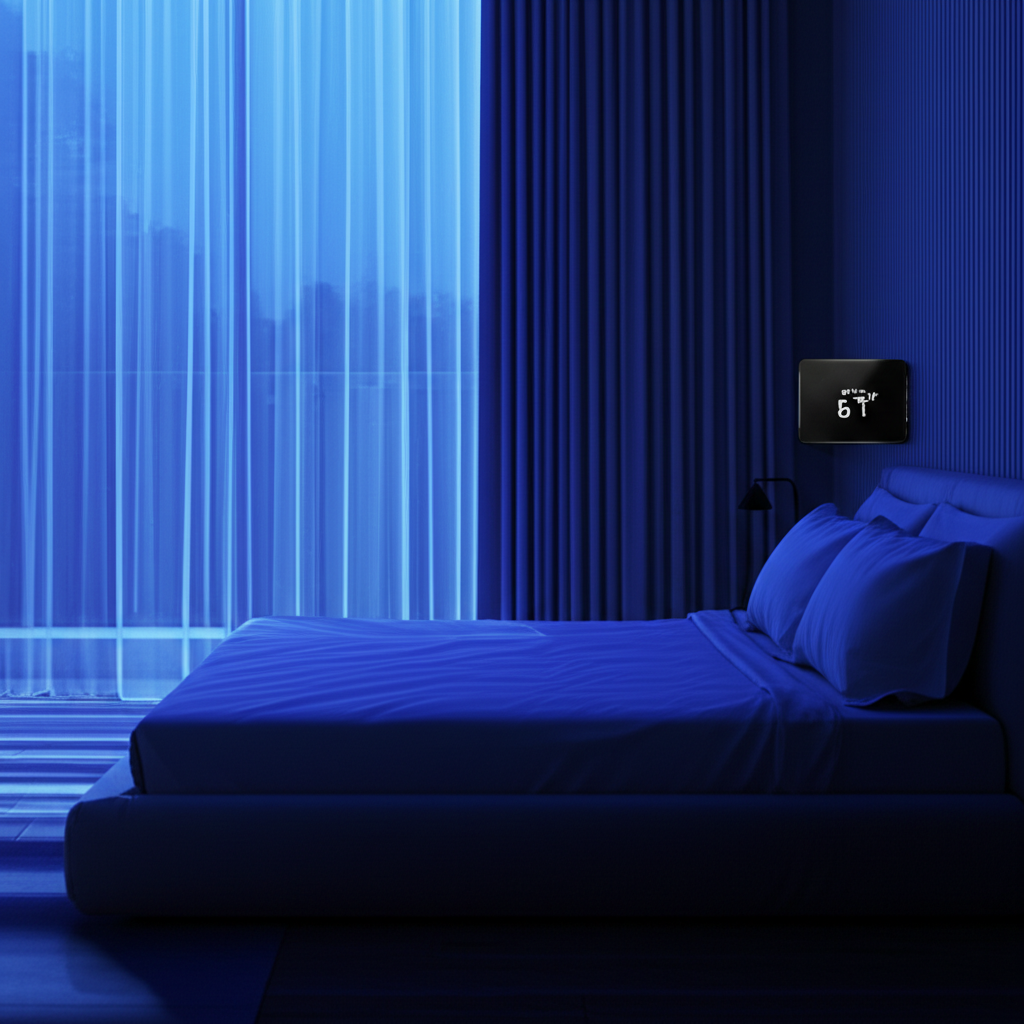
The Sleep Temperature Problem You Didn't Know You Had
You lie in bed for 45 minutes. Your mind races. You flip the pillow three times. You kick off the blankets. You pull them back on.
What if the real problem isn't stress or your mattress—but the temperature of the room?
Your body has a built-in sleep trigger that most people completely ignore: core body temperature. And the single most controllable factor in your environment is room temperature.
Here's what the science says: Your body needs to cool down by 2-3°F to initiate sleep. If your bedroom is too warm, you're literally fighting your own biology.
This isn't about comfort. This is about thermoregulation—the same mechanism that tells your body when to wake up, when to sleep, and how deep that sleep gets.
How Your Body Temperature Controls Sleep (The Science)
Your sleep-wake cycle is governed by your circadian rhythm, and temperature is one of its primary drivers.
Here's what happens:
In the evening (normal scenario):
- Your core body temperature peaks around 7 PM
- By bedtime, it naturally declines
- This drop signals your brain to release melatonin (the sleep hormone)
- Your body continues cooling until 3-4 AM (the deepest sleep window)
- Temperature rises again toward morning (part of the wake signal)
The problem: If your room is 72°F or higher, your body has to work harder to lose heat. This creates friction in the cooling process—your body can't drop temperature as efficiently, and melatonin release is delayed or reduced.
A 2013 study in Sleep Health Journal found that room temperatures above 70°F increased sleep latency (time to fall asleep) by an average of 27 minutes. Even worse: it reduced deep sleep time by 10-15%.
Why? Because your body is actively working to cool itself down instead of relaxing into sleep.
The Ideal Sleep Temperature Range
Research across multiple sleep studies points to a consistent optimal range:
65-68°F (18-20°C) is the sweet spot for most adults.
This applies whether you use:
- A blanket and top sheet
- A duvet
- Multiple layers
However, individual needs vary slightly based on:
- Body fat percentage — Leaner individuals may need 67-69°F; those with more body fat may prefer 64-66°F
- Metabolism — High metabolism = lower preference
- Age — Older adults often need slightly warmer (68-70°F)
- Sleep position — Back sleepers can tolerate slightly warmer; side/stomach sleepers often need cooler
The practical approach: Start at 67°F and adjust in 1-degree increments based on how you sleep.
Why Most Bedrooms Are Too Warm (And What's Sabotaging You)
The average American household keeps their bedroom at 70-74°F at night. This is too warm for sleep, and here's why:
1. Thermostat habits Most people set their home thermostat based on daytime comfort (70-72°F), then leave it there at night. They don't realize that sleepers need 4-6°F cooler than waking comfort.
2. Bedding overkill Duvet + top sheet + comforter + one too many blankets = a heat trap. You end up too warm even if the room temperature is correct.
3. Partner temperature preferences One partner sleeps hot; the other sleeps cold. You compromise at 70°F, which satisfies neither. (The sleep-cold partner loses.)
4. Summer cooling costs Running AC to 65-68°F seems expensive, so people compromise at a warmer temperature. They sleep poorly and wonder why.
5. Radiator heat in winter apartments You can't control radiator output in many older buildings. Cracking the window feels wasteful.
The Temperature-Sleep Connection: What Actually Happens
When your bedroom is at the right temperature (65-68°F), here's what improves:
Sleep Onset (Falling Asleep)
- Time to fall asleep: Decreases 15-25 minutes
- Why? Your body doesn't have to struggle with heat loss; cooling is passive and efficient
- Result: You fall asleep faster, even with the same amount of stress
Sleep Quality (The Deep Stuff)
- Deep sleep (Stages 3-4): Increases 10-15%
- Why? Optimal temperature is required for sustained deep sleep. Your brain can't maintain slow-wave sleep if you're thermally uncomfortable
- Result: Better restoration, better memory consolidation, better mood
Sleep Continuity (Staying Asleep)
- Arousals (wake-ups): Decrease 5-8 per night
- Why? Temperature fluctuations cause micro-awakenings. A stable cool temperature = fewer disruptions
- Result: Fewer middle-of-the-night wake-ups
REM Sleep (Dreams & Emotional Processing)
- REM duration: Increases slightly
- Why? REM is more sensitive to temperature disruption than other stages; cool rooms allow REM cycles to complete
- Result: Better emotional regulation, better creativity
How to Optimize Your Sleep Temperature (Practical Steps)
1. Get a Smart Thermostat (If Possible)
Best: Nest, Ecobee, or similar
- Set bedroom to 67°F at bedtime
- Gradually warm to 70°F around 6-7 AM (mimics natural wake signal)
- Cost: $200-300; ROI in energy savings + better sleep
- If renting: Many thermostats are removable; take it with you
No smart thermostat? Set your regular thermostat to 68°F at 9 PM, then 70°F at 7 AM manually, or use a reminder.
2. Audit Your Bedding
Go minimal:
- Option A (Cold sleeper): Fitted sheet + 1 lightweight blanket (not a duvet)
- Option B (Warm sleeper): Fitted sheet + thin top sheet (no blanket)
- Option C (Flexible): Duvet with 1 sheet layer (allows you to kick off the duvet if too warm)
Pro move: Use cotton or linen (breathable) instead of polyester (traps heat).
The goal: You should feel slightly cool when you first get into bed. As you warm up slightly, you hit the sweet spot.
3. Use a Space Heater or AC Unit for Your Side Only
If your partner has different temperature needs:
- Space heater on their side (warm sleeper sleeps in cool room, partner heats their side)
- Or: Split-zone air mattress (like OOLER or BedJet—pricier but effective)
4. Open a Window (Winter/Cold Climates)
If your room is 72°F in winter, crack a window 2-3 inches. Yes, it feels wasteful, but:
- Fresh air improves sleep quality independently
- You'll save the wasted energy from poor sleep (restlessness, early waking, daytime fatigue)
5. Block Out Heat Sources
- Close blinds/curtains during the day (prevents solar heating)
- Move away from radiators or heat vents
- Unplug devices that emit heat (TV, chargers near the bed)
Temperature Optimization + Other Sleep Factors
Temperature alone won't fix everything, but it's a force multiplier for other habits:
- Dark + 67°F = 2X melatonin response vs. 72°F + light
- Cool + low caffeine = better than either alone
- 65°F + consistent sleep schedule = deepest sleep
If you're already doing good sleep hygiene (no screens 1h before bed, no caffeine after 2 PM, consistent wake time), temperature optimization is the next high-leverage move.
What to Expect When You Optimize
Week 1:
- Falling asleep 10-15 minutes faster
- Fewer wake-ups (especially in the first 2 hours)
Week 2-3:
- Deeper, more restorative sleep
- Clearer mind in the morning
- More stable mood throughout the day
Week 4+:
- Full adaptation; benefits compound
- Total sleep need may actually decrease (better quality = less needed quantity)
The Bottom Line
Temperature is one of the few sleep factors you can control immediately and without spending money (beyond a thermostat).
Your bedroom should be 65-68°F. Not 70. Not 72. Cool enough that you need a thin blanket but not so cold you shiver.
If you've been sleeping poorly for months despite everything else being "right," this might be the missing piece.
Start tonight: Lower your thermostat to 67°F, use minimal bedding, and see what happens.
Related Articles on Sleep Smarter
- Why You're Still Tired After "Enough" Sleep: Understanding Sleep Cycles
- The Sleep Debt Problem: How to Calculate and Pay Down Your Sleep Deficit
- Sleep Tips for New Parents: Surviving the First Year
Sources:
- Czeisler, C. A., & Gooley, J. J. (2007). Sleep and circadian rhythms in humans. Cold Spring Harbor Symposia on Quantitative Biology, 72, 579–597.
- Okamoto-Mizuno, K., & Mizuno, K. (2012). Effects of thermal environment on sleep and circadian rhythm. Journal of Physiological Anthropology, 31(1), 14.
- Sleep Foundation. (2023). Bedroom temperature for sleep. Retrieved from https://www.sleepfoundation.org
Frequently Asked Questions
What is the best bedroom temperature for sleep?+
The ideal sleep temperature for most adults is 65-68°F (18-20°C). Individual preferences vary slightly based on metabolism, body fat, and age, but this range is optimal for deep, consolidated sleep.
How does room temperature affect sleep quality?+
Cool temperatures trigger the natural cooling process your body needs to initiate and maintain sleep. Too-warm bedrooms increase sleep latency by 15-25 minutes and reduce deep sleep by 10-15%.
Can you sleep better in a cool room?+
Yes — sleeping in a cool room (65-68°F) increases deep sleep time by 10-15%, reduces night wakings by 5-8 per night, and improves overall sleep consolidation compared to warmer temperatures.
Sleep Smarter Editorial Team
Our editorial team researches and writes evidence-based sleep content grounded in peer-reviewed science. All articles reference established sleep research from sources including the NIH, AASM, and Sleep Foundation.