Sleep Anxiety: Why Your Mind Won't Shut Off (And How to Fix It)
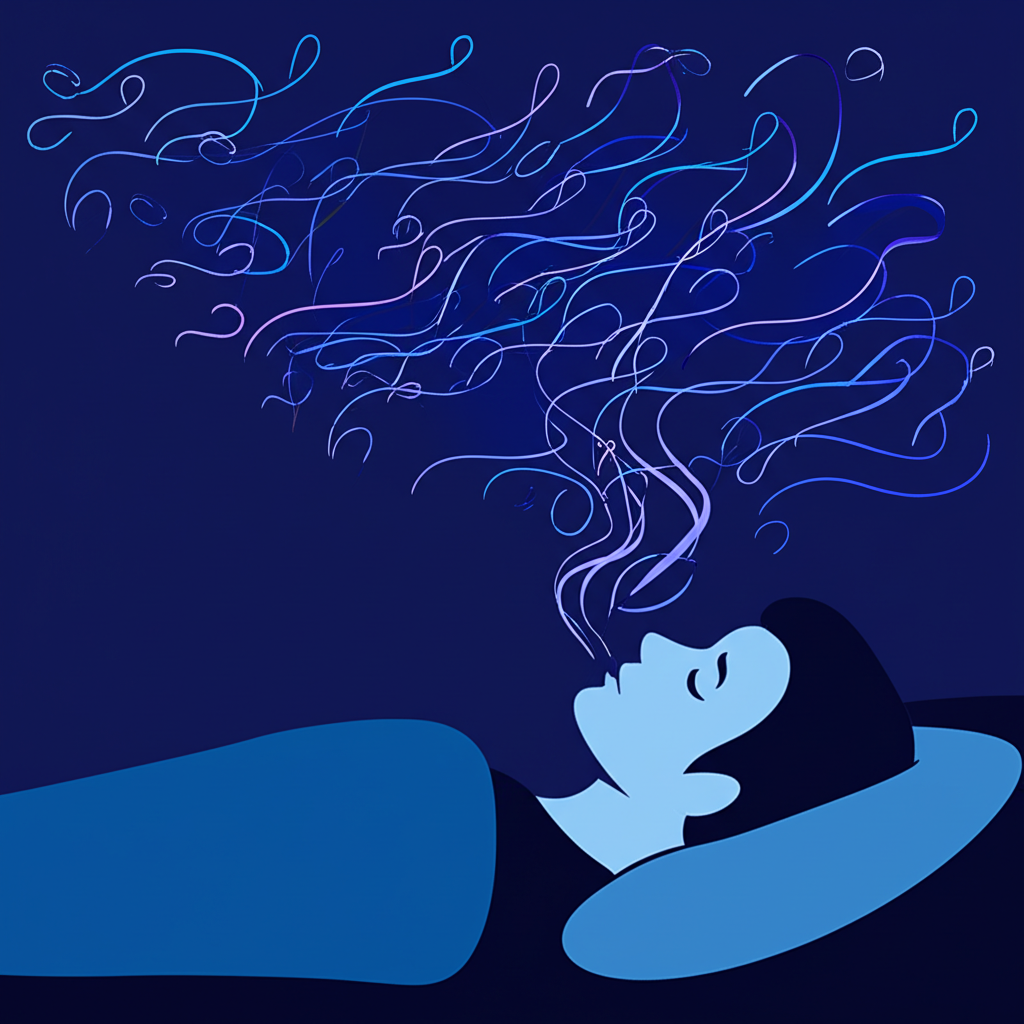
You're exhausted. You want nothing more than sleep. But the moment your head hits the pillow, your mind starts racing.
Sound familiar? You replay conversations from earlier in the day, run through tomorrow's to-do list, and then — worst of all — start stressing about the fact that you're not sleeping. The clock ticks. The anxiety grows. And somehow, the more desperately you want sleep, the more it escapes you.
This is sleep anxiety, and it affects over 40% of people who struggle with sleep. The cruel irony is that it hits hardest when you're the most exhausted — the exact moments when you need sleep most. But here's what most people don't know: sleep anxiety follows a predictable biological mechanism, which means it has a predictable solution.
In this article, you'll learn exactly why your nervous system fights against sleep when you're tired, and seven tactics backed by sleep science that can have you resting easier within three nights.
What Is Sleep Anxiety?
Sleep anxiety isn't the same as having an anxiety disorder. It's what happens when your nervous system activates at the exact moment you're trying to shut it down.
Think of it as performance anxiety for sleep. Just like a musician might freeze before a big concert, your brain starts treating sleep as something to succeed at — and that pressure triggers a stress response that makes sleep impossible.
Here's the basic cycle: you're tired, you get into bed, you try to fall asleep, you feel pressure to fall asleep, that pressure triggers a cortisol spike, cortisol wakes you up further, and now you're exhausted and wired at the same time. Your sympathetic nervous system — your fight-or-flight system — fires up adrenaline. Your heart rate rises. Your thoughts accelerate.
Sleep anxiety is especially common in high-achievers, people under chronic stress, and anyone prone to an anxious baseline. If you're someone who tends to overthink, your brain is applying that same thoroughness to the task of sleeping — and it's backfiring.
The good news: because this is a nervous system pattern, not a character flaw, it responds well to targeted techniques. You're not broken. Your nervous system has just learned the wrong thing.
Why This Happens: The Core Mechanism
Understanding why sleep anxiety occurs is half the fix. Most people try to brute-force their way through it, which makes everything worse.
The Performance Paradox
Sleep is one of the only biological functions that gets worse the harder you try. You can't will yourself to sneeze or digest food faster, and you can't force sleep. But unlike those other processes, we've collectively decided that failing to sleep is a problem to be solved — so we try harder.
Trying harder is exactly the wrong move. Effort creates arousal. Arousal defeats sleep. The harder you push, the more awake you become.
Anticipatory Anxiety
After a few nights of lying awake, something shifts. Your brain starts associating the act of getting into bed with the anxiety of not sleeping. Now bedtime itself becomes a trigger.
This is a conditioned response — the same mechanism behind any learned fear. Your brain isn't being irrational. It's pattern-matching. Bed used to mean sleep; now, in your nervous system's experience, it means lying awake feeling terrible. So it prepares accordingly.
The Thought Loop
The classic spiral looks like this: "I need to sleep" → "Why can't I sleep?" → "I'll be useless tomorrow" → "I'm going to ruin everything" → cortisol spike → you're now more awake than you were an hour ago.
This is compounded when you're already sleep-deprived. Sleep debt makes you more emotionally reactive, which means your thoughts hit harder and your nervous system escalates faster. The nights you most need sleep are often the nights this cycle is worst.
Seven Tactics That Actually Work
These aren't generic sleep hygiene tips. Each one works on a specific mechanism of sleep anxiety. Pick one or two to start — don't try all seven at once.
1. The "Permission to Stay Awake" Paradox
This one sounds ridiculous. Try it anyway.
The single most effective shift for performance-based sleep anxiety is removing the pressure to sleep. Tell yourself — genuinely — "I'm going to stay awake on purpose tonight. Rest is the goal, not sleep."
This isn't a trick you're playing on yourself. It's an accurate reframe. Your body needs rest. If sleep comes, great. But rest is valuable on its own, and it doesn't require performance.
Before bed, try a quick journal entry: "Tonight I'm resting, not trying to sleep." That's it. When you strip out the performance pressure, the arousal drops — and most people are asleep within 30 minutes of genuinely accepting this.
For skeptics: try the version "Sleep if it comes, but rest is enough." See what happens.
2. 4-7-8 Breathing (Physiological Reset)
When your thoughts are racing, your body is in sympathetic mode — fight-or-flight. You can physically switch it off with your breath.
Here's the technique: inhale through your nose for 4 counts, hold for 7 counts, exhale slowly through your mouth for 8 counts. Repeat 3-5 cycles.
The extended exhale is the key. When your exhale is longer than your inhale, you activate the vagus nerve, which signals your parasympathetic nervous system — your rest-and-digest system — to take over. Cortisol drops. Heart rate slows. The mental noise starts to quiet.
Use this the moment you notice thoughts starting to spiral, before the anxiety fully takes hold. Three cycles takes less than two minutes. Ten cycles puts most people to sleep.
3. Brain Dump + Worry Journal
Your brain rehearses unresolved thoughts because it's afraid you'll forget them. The fix is elegantly simple: write them down.
Two hours before bed, spend 10 minutes dumping everything in your head onto paper. Worries, to-dos, lingering frustrations, things you're anxious about — no organization needed, no editing, just get it out.
Once it's on paper, your brain's working memory can release it. The information is stored somewhere safer than your skull. Research on externalization consistently shows this reduces pre-sleep cognitive load — your brain isn't rehearsing the list because it knows the list exists elsewhere.
Pro tip: review your worry journal once a week during daylight hours. Often you'll find that most of what felt urgent at 11pm is minor by Wednesday afternoon.
4. Progressive Muscle Relaxation (PMR)
PMR combines mental focus with physical release, which is a powerful combination when your mind won't stop racing.
The technique: starting with your toes, tense each muscle group for 5 seconds, then deliberately release for 10 seconds. Work your way up — toes, calves, thighs, glutes, abs, chest, shoulders, arms, neck, jaw, face.
Two things happen simultaneously. Your body learns the physical difference between tension and release (many anxious people are chronically tensed without realizing it). And the mental task of tracking each body part gives your brain something concrete to focus on besides your worries.
PMR takes 15-20 minutes. Most people fall asleep before they finish. It also reveals where you chronically hold stress — neck and jaw are common culprits for high-stress individuals.
5. White Noise and Ambient Sound
Not everyone benefits from this, but for many anxious sleepers, external sound does something simple and effective: it gives your brain somewhere else to go.
Brown noise or pink noise (lower frequencies than classic white noise) tend to work better than standard white noise for anxiety. Rain sounds, ocean waves, or even a fan can serve the same purpose. The mechanism is straightforward — your attention gets gently pulled to the external stimulus instead of cycling through anxious thoughts.
Free options like myNoise.net or Noisli let you layer sounds and adjust frequencies. Test a few nights before deciding it does or doesn't work for you. Some people find any background sound irritating — trust your own response.
6. Weighted Blanket (Deep Pressure Stimulation)
A weighted blanket applies consistent, gentle pressure across your body — a sensation that mimics being held, which signals safety to your nervous system.
This works through deep pressure stimulation (DPS), a mechanism used in occupational therapy for anxiety and sensory disorders. The physical weight activates your parasympathetic nervous system directly, bypassing the mental loops that cognitive techniques target. For anxious sleepers, having both a mental and a physical approach often works better than either alone.
The general guideline is 10% of your body weight — so around 15-20 lbs for most adults. Many people notice a meaningful difference within 3-5 nights.
The investment is real: quality weighted blankets run $100-300. But if you've tried the cognitive approaches and still struggle, this addresses the physical side of the anxiety response in a way nothing else quite does. One caveat: some people feel trapped or overheated under weighted blankets. If that's you, it's not the right tool.
7. Anxiety-Release Meditation (Guided Body Scan)
This is different from generic "relaxation" — and that distinction matters.
A body scan meditation asks you to actively observe physical sensations rather than trying to relax or feel a certain way. You're not attempting to calm down. You're paying attention to what's actually happening in your body right now, without judgment.
That active observation interrupts the thought spiral because you're redirecting attention, not suppressing it. Mindfulness-based insomnia treatment (MBTI) has a solid evidence base — it changes the relationship between anxious thoughts and sleep, rather than just quieting thoughts temporarily.
Apps like Headspace, Calm, and the free sections of Insight Timer all have guided body scan meditations. Try the same practice three nights before deciding if it works — there's often an adaptation period where it feels awkward before it clicks.
What NOT to Do
These are the common mistakes that make sleep anxiety worse. If you're doing any of these, stopping them may help as much as starting the techniques above.
Don't watch the clock. Every time you check the time, you're calculating how much sleep you'll lose — which spikes anxiety further. Turn your phone face-down. Cover the clock.
Don't force it harder. If you've been lying awake for more than 20 minutes, get up. Do something calm and low-light (reading, gentle stretching) until you feel sleepy again. Staying in bed awake trains your brain that bed = restlessness.
Don't catastrophize the bad night. One night of poor sleep won't wreck your health or your performance — but believing it will creates a stress response that compounds the problem. You've survived bad nights before. You'll survive this one.
Don't rely on sleep aids as a primary strategy. Sleep aids can break an acute cycle in the short term, but they don't resolve the conditioned anxiety pattern. You can end up dependent on them and still anxious.
Don't scroll your phone in bed. Not just because of blue light — though bedroom temperature and light do matter — but because it reinforces the association between your bed and mental stimulation. Keep the bed for sleep and intimacy only.
When to See a Doctor
The tactics in this article work well for performance-based sleep anxiety — the kind triggered by stress, overthinking, and the pressure-to-sleep cycle.
But there are situations where professional support is the right call. If anxiety is showing up in other areas of your life — not just sleep — a therapist or doctor can help address the underlying clinical anxiety rather than just the sleep symptoms.
Red flags that warrant a conversation with a professional: panic attacks, persistent daytime worry that you can't control, or anxiety that doesn't improve after 2-3 weeks of consistently applying self-help techniques.
Also worth mentioning: if you're waking up gasping, choking, or your partner reports that you stop breathing, that's sleep apnea — a different condition entirely, and one that needs a sleep study.
For chronic insomnia that's lasted more than three months, Cognitive Behavioral Therapy for Insomnia (CBT-I) has the strongest evidence base of any treatment. It's more effective than medication long-term and doesn't have dependency risks.
The Bottom Line
Sleep anxiety is common, it's fixable, and it follows a predictable mechanism. You're not uniquely broken. Your nervous system learned a bad pattern, and like any pattern, it can be unlearned.
Here's what you have now: seven concrete tools that address different parts of the sleep anxiety cycle — cognitive (the permission paradox, brain dump, meditation), physiological (4-7-8 breathing, PMR), and environmental (white noise, weighted blanket).
You don't need to implement all seven. Pick one that resonates, try it consistently for three nights, and track what happens.
One last thing worth saying: you don't have to force sleep. Sleep isn't a performance, and you're not failing if it doesn't come immediately. Your only job is to create the conditions — calm body, quiet mind, comfortable environment — and then get out of sleep's way.
Sleep is a skill, not a fight. Let your nervous system learn that.
Ready to Go Deeper?
If sleep anxiety is part of a bigger pattern of poor sleep — trouble falling asleep, staying asleep, or waking up unrefreshed — then you need a structured reset, not just individual tactics.
The 7-Day Sleep Reset Protocol is a step-by-step system that rebuilds your sleep from the ground up. It covers sleep anxiety, sleep timing, nervous system regulation, and the environmental factors that most people overlook. At $17, it's less than a single bad night costs you in productivity and mood.
Get the 7-Day Sleep Reset Protocol →
Seven days. Real structure. Better sleep — not just tips you try once and forget.
Frequently Asked Questions
What is sleep anxiety?+
Sleep anxiety is when your nervous system activates at the moment you try to sleep — creating a cycle of pressure, cortisol spikes, and wakefulness. It's performance anxiety applied to sleep, not a clinical anxiety disorder.
Why can't I sleep even when I'm exhausted?+
When you're exhausted and desperate to sleep, the pressure to fall asleep triggers a stress response that keeps you awake. The harder you try, the more your sympathetic nervous system fires up — making sleep harder.
What is the best technique for sleep anxiety?+
The most effective first step is the "permission paradox" — deliberately removing the pressure to sleep by telling yourself rest is the goal, not sleep. This drops arousal levels and most people fall asleep within 30 minutes.
Does a weighted blanket help with sleep anxiety?+
Yes, for many people. Weighted blankets apply deep pressure stimulation (DPS) that activates the parasympathetic nervous system, signaling safety and calm. Use one that's approximately 10% of your body weight.
Sleep Smarter Editorial Team
Our editorial team researches and writes evidence-based sleep content grounded in peer-reviewed science. All articles reference established sleep research from sources including the NIH, AASM, and Sleep Foundation.