Magnesium Glycinate and 3AM Wake-Ups: The Supplement That Might Be Disrupting Your Sleep
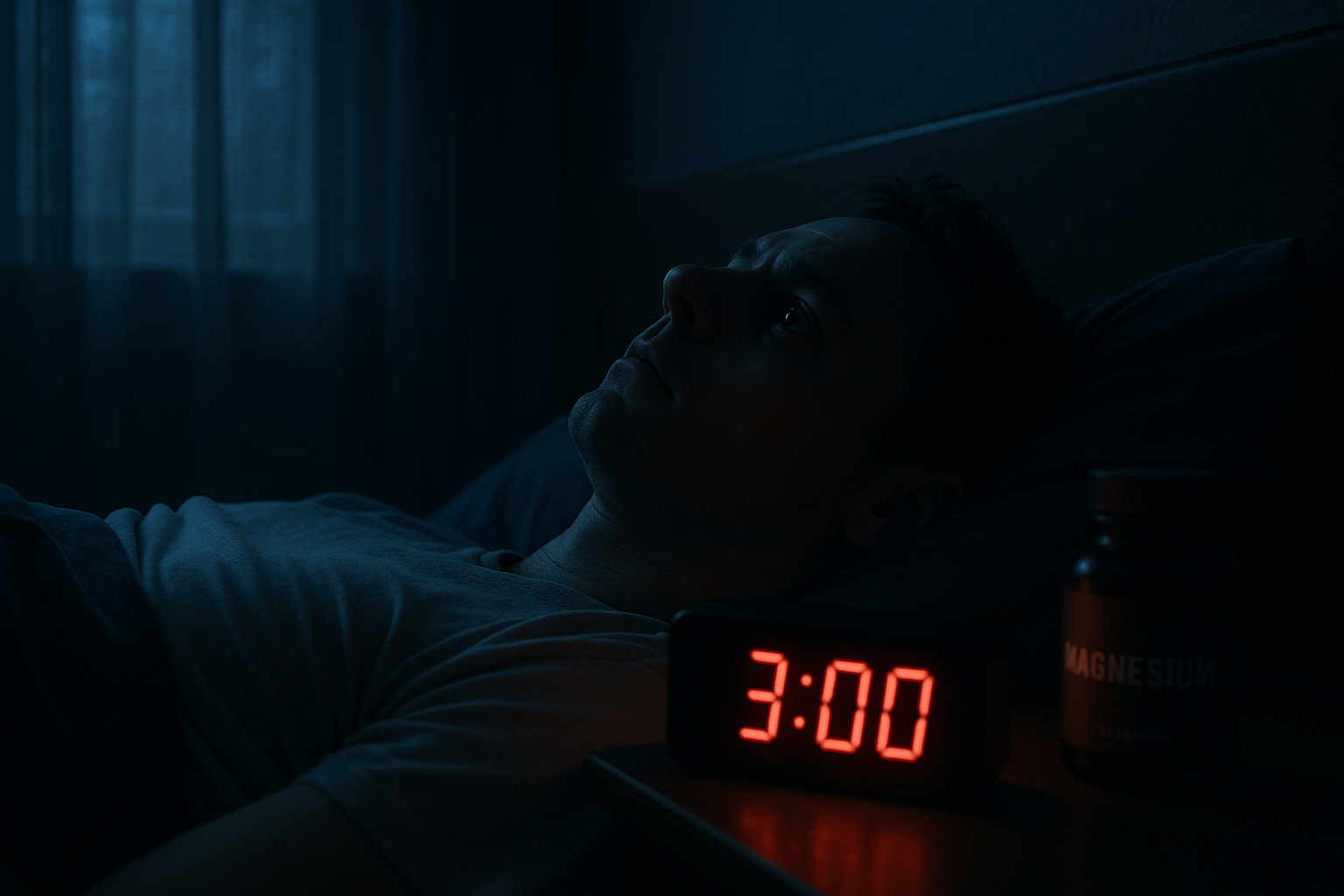
You fall asleep fine. But somewhere around 3 in the morning, your eyes snap open — mind already running, heart beating a little too fast, staring at the ceiling while the rest of the world sleeps. You check your phone. Try to relax. Fail. By the time you drift back off it's nearly 5, and two hours later your alarm makes it all feel pointless. If this is your life, you're not alone — and more importantly, you're not broken. But there's a very specific reason it keeps happening at 3AM, and one cause in particular that almost nobody is talking about.
Why 3AM — Not 2AM, Not 4AM?
Your sleep isn't a single stretch of unconsciousness. It cycles through four stages roughly every 90 minutes — moving from light sleep, into deep (slow-wave) sleep, and back through a period of REM (rapid eye movement) sleep where dreaming happens. A typical eight-hour night contains four or five of these cycles.
Here's the critical part: the first half of your night is dominated by deep, restorative slow-wave sleep. The second half shifts heavily toward lighter REM sleep. By around 3AM — roughly four and a half hours into sleep for most people who go to bed around 10:30 or 11 — your body has finished its deepest sleep work and is cycling through progressively lighter stages.
That transition is where things can go wrong.
At this same time, your cortisol — the wake-promoting hormone — is beginning its natural early-morning rise. Cortisol isn't your enemy; it's what gives you energy to function during the day. But it starts climbing around 2-4AM, hours before you actually need to be awake. If anything amplifies that signal even slightly — stress, blood sugar instability, temperature, or certain supplements — your brain can interpret it as "time to be alert" and pull you out of sleep at exactly the wrong moment.
So 3AM isn't random. It's the intersection of your lightest sleep, rising cortisol, and any compounding factors that push you over the edge into full wakefulness.
The Supplement That Might Be Waking You Up
Here's the counterintuitive part — and the one that recently lit up insomnia forums when someone posted about it.
If you've been taking magnesium glycinate to help you sleep, it might actually be contributing to your 3AM wake-ups.
Magnesium glycinate is a well-researched form of magnesium. A 2026 randomized controlled trial confirmed that magnesium bisglycinate reduced sleep onset latency by over 17 minutes and extended total sleep time in participants with sleep difficulties. The evidence is real — magnesium does support sleep for many people.
But dosing and timing matter enormously, and most people get both wrong.
Magnesium glycinate is fast-absorbing. When you take a large dose (400mg or more) right before bed, the initial sedating effect fades within three to four hours — which brings you right back to 3AM. Worse, in some people, magnesium can stimulate the nervous system rather than calm it, especially at higher doses. Magnesium plays a role in activating NMDA receptors, and in sensitive individuals, a spike followed by a rapid drop can actually increase arousal during light sleep stages.
The posts about this pattern on Reddit aren't theoretical. People who reduced their magnesium glycinate dose reported sleeping through the night for the first time in months.
If you're taking magnesium glycinate and waking up at 3AM consistently, try this for one week:
- Reduce your dose to 100-200mg (not 400mg+)
- Take it with dinner instead of right before bed
- Or switch to magnesium threonate (a form with better brain-barrier penetration and more consistent calming effects)
If you want to try a well-reviewed low-dose option, Doctor's Best High Absorption Magnesium is a commonly recommended starting point. For the threonate form, Life Extension Neuro-Mag has strong reviews specifically for sleep maintenance (staying asleep through the night) rather than just sleep onset.
What Happens in Your Brain When You Wake Up at 3AM
Before we get to all the other causes, it's worth understanding the exact neurological sequence of a 3AM wake-up — because understanding it changes how you respond to it.
When you wake, your brain's arousal system (specifically the locus coeruleus, which secretes norepinephrine) activates almost instantly. Within seconds you're conscious. Within a minute, your prefrontal cortex — the planning, worrying, time-calculating part of your brain — comes fully online. This is why you immediately check the clock and start doing math: It's 3:14. I need to be up at 6:30. That's three hours and sixteen minutes. I need to fall back asleep right now.
That calculation, that urgency, is the worst thing you can do.
Sleep pressure builds through something called adenosine accumulation — a chemical byproduct of waking brain activity that creates the "sleep drive" your body relies on to fall and stay asleep. Anxiety about not sleeping consumes the cognitive resources you need to let adenosine do its job. The more you try to force sleep, the more activated your nervous system becomes, and the longer you stay awake.
This is why some people lie there for two hours getting progressively more frustrated while their partner falls back asleep in ten minutes. It's not a willpower failure. It's a feedback loop between your monitoring mind and your arousal system — and once it's running, it's very hard to break through thinking alone.
The Other Culprits Worth Checking
Magnesium is the surprise on the list. But it's not the only cause. Here are the other root causes worth auditing, ranked by how commonly they contribute to the 3AM wake-up pattern:
1. Blood Sugar Drops
When blood glucose falls too low during the night, your body releases adrenaline and cortisol to compensate — a survival response that also wakes you up. This is especially common if you:
- Eat dinner early (before 6pm) and don't eat again
- Consume a lot of refined carbohydrates or alcohol in the evening (alcohol causes a rebound blood sugar crash around 3-4 hours after drinking)
- Have any degree of insulin resistance
The fix: eat a small protein-and-fat snack before bed — a handful of nuts, a small piece of cheese, or a tablespoon of nut butter. Not a carb-heavy snack; fat and protein slow glucose release overnight.
2. Temperature Dysregulation
Your core body temperature needs to drop about 1-2°F to initiate and maintain deep sleep. If your sleeping environment is too warm — or if you warm back up during the night — your body struggles to stay in deeper sleep stages.
This is one of the more underrated causes of middle-of-night waking. Most people assume their mattress or pillow is to blame, when the issue is heat retention in their bedding. If you wake up feeling even slightly warm, this is worth addressing.
Temperature-regulating bedding isn't just marketing speak. Silk and certain technical fabrics actively wick heat and moisture away from the body rather than trapping it. The Promeed CoolRest Cooling Comforter→ is designed specifically for hot sleepers and uses materials that regulate temperature throughout the night rather than just at bedtime. Pairing it with a silk pillowcase→ (which stays noticeably cooler than cotton or polyester) can make a meaningful difference if temperature is your trigger.
3. Stress and the Hyperarousal Cycle
This one compounds everything else. Chronic psychological stress keeps cortisol elevated at night even when it shouldn't be. It also creates "conditioned arousal" — your brain associates your bed with wakefulness, anxiety, and the dread of another bad night, which makes waking up more likely and falling back asleep harder.
The 3AM wake-up becomes a self-reinforcing loop: you wake up, check the time, do the math on how many hours are left, feel the familiar spike of dread, and now you're fully alert. The anxiety about not sleeping is often worse than the lost sleep itself.
If you recognize this pattern, the most evidence-backed intervention isn't a supplement. It's Cognitive Behavioral Therapy for Insomnia (CBT-I), which directly targets the conditioned arousal loop. The stimulus control component — getting out of bed if you can't sleep, rather than lying there getting increasingly activated — has a stronger long-term track record than any medication or supplement on the market.
4. Sleep Apnea
Worth mentioning because it's dramatically underdiagnosed, especially in people who don't fit the stereotypical profile (overweight, loud snorer). You don't have to snore to have sleep apnea. Women in particular are often undiagnosed because their symptoms — waking repeatedly, non-restorative sleep, morning headaches — are attributed to stress or hormones rather than airway obstruction.
If you wake up with a headache, your partner notices you've stopped breathing, or no amount of sleep improvement tactics helps, get screened. A home sleep study is now accessible and relatively inexpensive.
→ Not sure what's actually disrupting your sleep? The Sleep Reset Protocol walks you through a 7-day process for identifying and eliminating the specific patterns holding you back — not a generic checklist, but a structured protocol for people who've already tried the basics.
The 7-Day Fix Protocol
Pick the one or two causes most likely to apply to you (don't try to fix everything at once — you won't know what worked), then follow this sequence:
Days 1-3: Audit and cut
- If taking magnesium glycinate at high doses right before bed → cut to 150mg with dinner
- If drinking alcohol within 3 hours of sleep → eliminate for the test week
- Note your wake-up time each morning without changing your bedtime
Days 4-5: Environment adjustment
- Drop your room temperature to 65-68°F (18-20°C) if possible
- Switch to lighter bedding or open a window
- If your comforter is thick or synthetic, try sleeping without it for two nights
Days 6-7: Stimulus control
- If you wake up at 3AM and can't fall back asleep within 20 minutes → get out of bed, go to another room, do something calm and non-stimulating (reading under low light, not scrolling)
- Return to bed only when you feel genuinely sleepy again
- This feels counterintuitive but breaks the conditioned arousal cycle faster than lying in bed willing yourself back to sleep
Track only wake-up times and total sleep (rough estimate). Don't obsess over metrics; the goal is to notice a pattern, not optimize a spreadsheet.
One overlooked lever in this protocol: your mattress support. If you're waking in the night from pain, discomfort, or constantly repositioning, no supplement or schedule tweak will fully compensate. Latex mattresses in particular — especially natural latex — are known for pressure distribution that reduces the tossing and turning that fragments sleep. The Latex Mattress Factory Luxerion Dunlop→ and Luxerion Hybrid→ are worth looking at if you've ruled out all the behavioral and environmental causes and still can't stay asleep. Unlike memory foam, latex doesn't trap heat, which also addresses the temperature issue simultaneously.
If adjustable firmness is more your priority — particularly useful if you and a partner have different needs — the Airpedic 700→ allows each side of the bed to be set independently, which removes one more variable from the equation.
When to Seek Help
If you've been waking up at the same time for more than four weeks, none of the above moves the needle, and you're experiencing significant daytime impairment — not just tiredness, but actual cognitive fog, mood changes, concentration failure — it's time to talk to a doctor or seek a CBT-I specialist. Chronic insomnia has good treatment options when it's addressed properly rather than white-knuckled through.
What it almost never requires is simply trying harder to sleep. Sleep is a biological process you can support — not one you can force.
Frequently Asked Questions
Can magnesium glycinate cause you to wake up at 3AM?+
Yes, in some people. Taking a high dose (400mg+) right before bed means the sedating effect fades after 3-4 hours, which coincides with your lightest sleep stage around 3AM. Reducing the dose to 100-200mg and taking it with dinner (not at bedtime) often resolves the issue.
Why do I always wake up at exactly 3AM?+
3AM is when most people complete their deepest slow-wave sleep cycles and transition into lighter REM sleep. It also coincides with your cortisol starting to rise. If any factor amplifies that arousal signal — stress, blood sugar drops, heat, or certain supplements — 3AM is when it tips you into full wakefulness.
What should I do when I wake up at 3AM and cannot fall back asleep?+
Avoid checking the clock or calculating how many hours are left — this creates anxiety that keeps you awake longer. If you cannot fall back asleep within 20 minutes, get out of bed, go to another room, and do something calm until you feel sleepy again. This is the stimulus control technique from CBT-I and is the most evidence-backed approach.
What is the best magnesium form for staying asleep through the night?+
Magnesium threonate (L-threonate) has better brain-barrier penetration than glycinate and tends to produce more consistent calming effects for sleep maintenance — staying asleep — rather than just sleep onset. Magnesium glycinate works well for many people, but at a lower dose (100-200mg) taken with dinner rather than immediately before bed.
How do I know if blood sugar is causing my 3AM wake-ups?+
Common signs include waking up feeling slightly shaky, anxious, or hungry, and falling back asleep easily once awake. Try a small protein-and-fat snack before bed (nuts, cheese, nut butter) for one week. If your 3AM wake-ups reduce or stop, blood sugar instability was likely a contributing factor.
Keep Reading
Sleep Smarter Editorial Team
Our editorial team researches and writes evidence-based sleep content grounded in peer-reviewed science. All articles reference established sleep research from sources including the NIH, AASM, and Sleep Foundation.